

MAKING TEXTILES IN COLONIAL CONNECTICUT
Jamie Eves and Peggy Church
Before the Industrial Revolution, thread and cloth were made by hand, using a variety of wood or iron tools and small machines. Making textiles was both hard, time-consuming work and required years of skill and practice. Not surprisingly, then, people owned fewer textiles than we do today. Textiles difficult to produce and consequently expensive. Until the invention of the cotton gin by Eli Whitney, Catharine Littlefield Greene, and others in 1793, cotton — like silk — was an expensive luxury fabric, the result of the many hours of labor required to pick the sticky seeds out of the bolls by hand. Less expensive, and hence more commonplace, were linen (made from flax), wool, and hemp. Frequently, linen and wool threads were combined to make cloth that was a mixture of the two, known as linsey-woolsey. The virtual exhibit displays below illustrate the processes of making cloth from linen and wool.
Most preindustrial textile production was done by hand. A good example is America’s most famous textile, the Star-Spangled Banner that flew over Fort McHenry at Baltimore during the War of 1812 and was immortalized in poem and song by Francis Scott Key (with a fifth, Civil War-era verse added later by Oliver Wendell Holmes). But some of the work, such as fulling and carding, was sometimes done in small, family-run, water-powered preindustrial mills. The relics of these mills — and of the dams and raceways that powered them — are still visible on the rural Connecticut landscape.
Making Linen from Flax: The Process

Making Linen: Flax Break
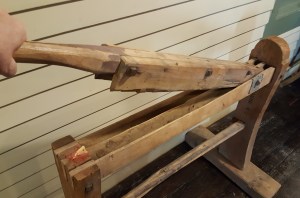
Above: Flax break. Linen is made from a plant called flax. The fibers in flax are in the stems of the plant. After the flax has been harvested, retted (soaked), and then dried, the stems are put in a flax break, to break the dry, stiff stems and begin the process of separating the fibers from the rest of the stems. After breaking the flax, the next step would be to scrape the supple fibers (on the outside of the stems) from the stems’ stiff, woody cores by scraping with a scutching board and wooden knife.
Making Linen: Hetchel

Above: Hetchel, or hackle. Once the fibers were separated from the rest of the stems, the fibers would be pulled through the tines (iron or steel spikes) of hetchels. Depending on the fineness desired, the fibers could be pulled through a succession of hetchels, with ever smaller, finer tines.
Making Linen: Flax Wheel

Above: Flax wheel. Wheels for spinning flax were smaller and more intricate than the great wheels used to spin wool — although, truth to tell, experienced spinners could make do with any type of wheel that was available. Spinners sat on stools and used their feet to operate the treadles that made the wheels spin. The Mill Museum has several flax wheels in its collection.
Making Flax: Flax Wheel Flyer

Above: Flyer on flax wheel.
Making Wool from Fleece: The Process

Making Wool: Cards

Above: Cards. Cards were used to brush or comb the wool, to align the fibers in preparation for spinning.
Making Wool: Great Wheel

Above: Great wheel, or wool wheel — also called a walking wheel. Great wheels lacked treadles and were operated while standing. The spinner also had to walk back and forth to put the proper tension on the spun yarn.
Making Linen or Wool: Niddy Noddy

Above: Niddy noddy, used for winding spun linen or woolen yarn in order to measure how much had been made. Twice around the niddy noddy was one yard.
Making Linen or Wool: Quill Winder

Above: Quill winder, used for winding skeins of yarn.
Making Linen or Wool: Click Reel

Above: Click reel, also used for winding yarn or thread. These were called “click” reels because the machine made a loud click when certain lengths of yarn had been wound onto the reel. Some click reels had counters in the form of dials — like a one-handed clock — that counted the number of revolutions; these were called “clock” reels. The Mill Museum has a clock reel on display.
Making Linen or Wool: Counting Mechanism on a Click Reel

Above: Counting mechanism on click reel.
Making Linen or Wool: Swift

Above: Swift. A swift was another mechanism for winding thread or yarn.
